Why Western Australian marble is returning to kitchen benchtops
For years, the Australian kitchen has been shaped by an appetite for engineered stone, polished porcelain and highly controlled surfaces. These materials offered consistency, broad colour ranges and a practical answer to the demands of family life. Yet the preference for flawless uniformity is beginning to soften. Designers and homeowners are increasingly drawn to surfaces that carry geological variation, regional character and the evidence of skilled fabrication.
Western Australian marble sits within that shift. Its appeal is partly visual, with cloudy veining, mineral movement and softened tones that can bring depth to a restrained interior. It is also connected to a wider interest in materials that have a traceable story, can be repaired or refinished, and belong meaningfully to the places where they are used.
The renewed interest does not mean marble has become an effortless or universally suitable choice. A benchtop must withstand spills, heat, impact and regular cleaning. The comeback is more considered than nostalgic: it is about selecting the right stone, finish and detailing for the room, then allowing its natural variation to become part of the design.
A more regional view of materiality
Western Australia has long encouraged a strong relationship between architecture and geology. The state’s landscapes move from coastal limestone and pale sands to iron-rich ranges, granite outcrops and richly coloured mineral formations. That geological diversity has helped shape a design culture comfortable with tactile surfaces and materials that reveal their origins.
In a kitchen, locally sourced or regionally associated stone can make an otherwise globalised interior feel more grounded. Cabinetry, appliances and hardware may be manufactured across different countries, but a marble surface can provide a physical connection to the site and its wider environment. It gives the room a sense of belonging rather than treating the benchtop as a neutral commodity.
The phrase “Western Australian marble” can describe several supply pathways, so specification requires care. Some stone may be quarried in the state, while other projects may use Australian marble fabricated by Western Australian makers. Asking where the block was extracted, where it was cut and how it will be sealed creates a clearer material story and avoids vague claims about provenance.
Why designers are moving away from perfect uniformity
Large-format manufactured surfaces have made it possible to achieve a clean, continuous appearance with impressive technical performance. Their popularity is understandable, particularly in open-plan kitchens where a benchtop may need to coordinate with splashbacks, islands and full-height cabinetry. Marble offers a different visual language. Its veining is not repeated by a printer or engineered into a consistent pattern; every slab has its own rhythm.
That irregularity works especially well in interiors that combine simple forms with expressive materials. Flat-panel joinery in timber, painted finishes or brushed metal can give marble enough space to be noticed without allowing it to dominate. A quiet grey-white stone may support a minimalist scheme, while warmer cream, green or rose undertones can complement the softer palette emerging in Australian residential interiors.
The surface also changes with light. Morning sun can draw out translucent edges and fine mineral lines, while evening lighting may make the same slab appear warmer and more atmospheric. For designers, this gives a kitchen a quality that is difficult to reproduce with a perfectly uniform product.
Performance depends on the specification
Marble is a relatively soft and porous natural stone, which means its beauty comes with responsibilities. Acidic ingredients such as lemon juice, vinegar and wine can etch a polished surface, leaving a dull mark rather than a removable stain. Oils and strongly coloured foods may also require prompt attention. These characteristics do not disqualify marble from kitchen use, but they should be made clear before installation.
A honed finish is often a practical choice for contemporary kitchens. It reduces the visual contrast of small etches and gives the stone a soft, velvety appearance. A polished finish can intensify colour and veining, but it may make surface marks more apparent. Brushed, leathered or lightly textured finishes offer further options, although their maintenance requirements and suitability should be assessed with the fabricator.
Edges matter as much as the slab itself. A small arris or softened edge can reduce the likelihood of chipping, particularly around an island that receives constant traffic. Sufficient support, carefully positioned joins and an experienced installer are essential. The best result comes from treating marble as a constructed architectural element rather than simply ordering a decorative sheet.
How marble compares with other benchtop choices
Material selection is most useful when it reflects the habits of the household, the architecture of the room and the desired ageing process. There is no single surface that performs perfectly in every category. The comparison below offers a starting point, but the exact result will depend on the product, finish, fabrication quality and maintenance routine.
| Material | Visual character | Resistance and care | Sustainability considerations | Best suited to |
|---|---|---|---|---|
| Western Australian or Australian marble | Unique veining, mineral depth and natural variation | Requires sealing and prompt care; can etch and scratch | Strongest story when provenance is clear and offcuts are used | Feature islands, low-volume kitchens and tactile interiors |
| Engineered stone | Consistent pattern and controlled colour | Generally easy to clean; product specifications vary | Depends on composition, manufacturing and end-of-life options | Cohesive, high-use kitchens seeking visual consistency |
| Porcelain slab | Broad design range, often replicating stone or concrete | Highly resistant to heat and staining, though edges can chip | Efficient formats can reduce waste; transport and production still matter | Contemporary kitchens requiring robust, low-maintenance surfaces |
| Granite | Speckled or dramatic natural pattern | Hard-wearing and relatively resistant to heat and scratching | Natural extraction has an environmental cost; long lifespan can offset replacement | Busy kitchens and projects seeking durability |
| Timber | Warm grain, softness and craft appeal | Requires oiling or refinishing; vulnerable to water and heat | Renewable when responsibly sourced and repairable | Breakfast bars, joinery-integrated worktops and warm interiors |
| Stainless steel | Industrial, seamless and reflective | Hygienic and heat resistant; scratches and fingerprints show | Highly recyclable and long lasting | Professional-style kitchens and hospitality spaces |
The table also highlights why marble is being reconsidered rather than simply replacing every other option. It occupies a particular place between performance and expression. Its value lies in how it ages, how it relates to surrounding materials and how convincingly it supports the architecture.
Making the slab work with contemporary joinery
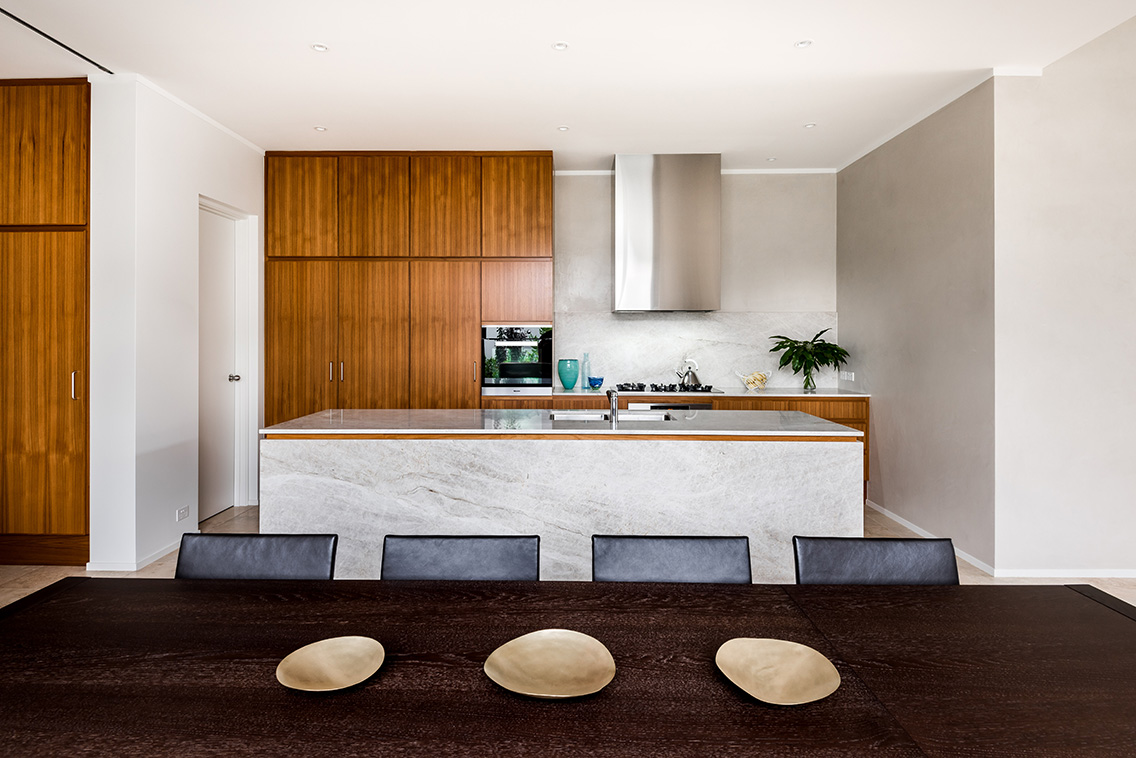
A marble benchtop does not need to be paired with traditional cabinetry. In recent residential work, it is often set against very crisp joinery, integrated appliances and minimal handles. The contrast makes the stone feel current: a material with deep geological time becomes part of a precise, modern composition.
Colour matching should begin with undertones rather than obvious swatches. A cool white marble may sit comfortably beside blue-grey cabinetry and stainless steel, while a cream stone can bring warmth to dark timber, bronze hardware or terracotta tiles. Looking at full slabs is critical because small samples rarely reveal the scale and direction of the veining.
The island is often the most effective place to use a more expressive piece. A single slab can become the visual centre of the kitchen, while quieter material is used along the perimeter. Waterfall ends, mitred edges and carefully aligned joins can create a monolithic effect, but restraint is usually more successful than excessive shaping. Letting the stone remain legible is part of the design.
Material relationships should extend beyond the kitchen. A project might repeat the marble in a bathroom shelf, window reveal or small furniture detail, but repetition is not mandatory. A renovation that balances old and new can draw useful lessons from salvaged door hardware, where existing elements are valued for their patina rather than forced into pristine uniformity.
A more responsible approach to natural stone
The sustainability case for marble is nuanced. Quarrying and transporting stone require energy, water and land, and a locally available material is not automatically low impact. The most responsible specification begins with asking difficult practical questions: how far has the slab travelled, what extraction practices are used, and can the material be sourced in a suitable size without excessive waste?
Longevity is one of marble’s strongest qualities. A well-made stone benchtop can remain in service for decades, then be refinished, reshaped or reused. Small remnants can become shelves, trays, side tables or splashback details. Designers who plan these secondary uses early can reduce the amount sent to landfill and create a more coherent material palette across the project.
Maintenance is part of sustainability too. A surface that is replaced because its natural marks are considered unacceptable has a very different environmental story from one that is allowed to develop patina. Homeowners should understand that etching and fine scratches are signs of use, not necessarily failure. Choosing a honed finish and a forgiving design can make this transition easier.
That attitude reflects a broader movement in Australian design towards adaptation, repair and thoughtful reuse. Contemporary’s editorial coverage provides a wider view of this conversation, from material experiments to residential and commercial projects across the country. Its design stories place individual products within the larger culture of architecture, craft and making.
Details that make the choice last
Before committing to a slab, inspect it under the lighting conditions of the kitchen and discuss the likely position of joins, cut-outs and appliances. A vein that looks balanced across a full island may become fragmented around a sink or cooktop. Digital templating and careful slab layout can improve the result, but they cannot eliminate every natural variation.
Sealing should be treated as a maintenance system rather than a one-time guarantee. Ask the fabricator which sealer is appropriate, how often it should be renewed and which cleaning products are safe. Avoid abrasive powders and highly acidic cleaners, and use boards or trivets where heat and sharp objects are likely to be an issue.
The most convincing marble kitchens are rarely the ones that pretend the stone is indestructible. They are spaces where the material has been selected with clear eyes and detailed with confidence. A small mark, a softened edge or a shift in tone can become part of the kitchen’s record of use, giving it a character that synthetic perfection cannot easily imitate.
Practical principles for specifying marble
Use these recommendations to make a natural-stone benchtop feel deliberate, durable and connected to its setting:
- Confirm the stone’s quarry, fabrication location, sealing system and available documentation before approving the specification.
- View the complete slab in natural and artificial light, then map the most important veins around sinks, joins and appliance cut-outs.
- Choose a honed or textured finish if you want everyday etching and minor scratches to be less visually prominent.
- Design with offcuts in mind, using remnants for shelves, serving boards, bathroom ledges or furniture components.
- Explain cleaning, sealing and heat protection to everyone who will use the kitchen so the stone can age as intended.
Western Australian marble is returning to the kitchen because it offers something beyond colour and performance: a sense of place, variation and time. Its success depends on honest specification and skilled detailing, but that is precisely what makes it relevant to contemporary practice. For project inspiration and a closer look at the people shaping the local design community, explore the Wine in Design program, then bring that conversation into your next material selection, renovation or architectural brief.