The Woodturner Behind Australia’s Custom Bowl Blanks
Before a turned vessel appears on a console, kitchen island or styled shelf, it often begins as an unremarkable block of timber. The shape is hidden inside it, waiting for a maker to read the grain, judge the moisture and decide how much material can be released without losing the character of the wood.
In Perth, that work is being carried out by a small network of specialist woodturners supplying custom bowl blanks to interior stylists, furniture makers and design studios. Among them is Rowan Hale, a second-generation craftsperson whose workshop sits on the industrial fringe between Bassendean and Bayswater. His orders are rarely for finished bowls. They are for possibility: the right species, scale, thickness and surface for a project still taking shape.
Hale’s practice sits in a productive space between forestry, furniture production and visual merchandising. A stylist may send a reference image, a rough diameter or a palette of warm browns and muted greens. Hale then works backwards, selecting timber that can support the intended object while leaving enough room for the final turner to make decisions. It is a quiet form of collaboration, but one that has a visible effect on Australian interiors.
Reading Timber Before It Becomes An Object
A bowl blank is a prepared piece of wood, usually cut oversized and left with enough material for a turner to create a vessel on a lathe. It may be round, square, rectangular or intentionally irregular, depending on the direction of the grain and the proposed design. The blank is not a finished product; it is a carefully managed beginning.
For Hale, selection starts with the log rather than the brief. He looks for insect trails, inclusions, bark pockets, spalting and changes in colour. These features can be liabilities in a structural component, but they may become the visual centre of a sculptural bowl. A clean, stable blank suits a hospitality fit-out requiring a set of consistent vessels. A split-edged block may be more appropriate for a residential project looking for a single expressive piece.
“People often ask for a particular size first,” Hale says. “But the timber has a say in whether that size will work. You can’t always force a piece of wood to become the object someone has drawn.”
That exchange between intention and material is central to the appeal of hand-turned timber. It also explains why interior stylists increasingly specify the blank itself. They are commissioning a certain kind of rawness, rather than ordering an anonymous decorative bowl from a catalogue.
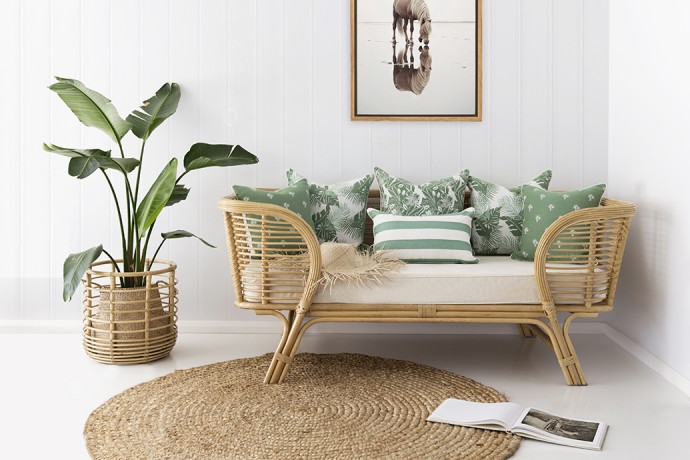
The interest in earthy, botanical interiors has strengthened that demand. Rich greens, organic forms and tactile finishes are appearing across Australian residential work, as explored in this look at green interiors. A locally sourced bowl blank gives those palettes a physical anchor, particularly when its colouring comes from the timber rather than a stain.
A Perth Workshop Shaped By Climate
Perth’s climate makes woodturning a technical exercise as much as a craft. Hot summers, low humidity and large shifts between indoor and outdoor conditions can encourage timber to dry quickly and develop cracks. A block that behaves perfectly in a damp shed near the coast may respond differently once it is installed in an air-conditioned apartment in West Perth.
Hale stores rough-cut blanks in stages, allowing them to acclimatise before they are supplied. Some pieces are sealed on the end grain to slow moisture loss, while others are turned green, left to move, and returned to the lathe once they have stabilised. The timing depends on species, thickness and the object’s intended use. There is no universal drying schedule that removes the need for judgement.
The workshop’s location matters, too. Perth has a strong relationship with local hardwoods, from richly coloured jarrah to pale marri marked by dark gum veins. Reclaimed boards from demolition sites, storm-felled branches and offcuts from furniture manufacturers can all enter the supply chain, though each source brings different questions about provenance, pests, nails and embedded grit.
Native timber is not simply a material to be collected wherever it appears. Responsible makers work with licensed suppliers, salvaged stock and documented sources, particularly when dealing with species that are subject to harvesting controls. Hale keeps a record of where larger pieces come from and rejects timber if its history is unclear. The paperwork is less romantic than the finished object, but it is part of making with integrity.
On a typical Perth morning, the workshop door may be open to a dry easterly and the radio carrying local traffic updates. By mid-afternoon, the temperature inside the shed can change the way a blank cuts. This is the practical reality behind the polished images used by design studios: the material is always responding to its environment.
Supplying Stylists With Room To Decide
Interior stylists rarely need a maker to deliver a single predetermined shape. They need options that can hold their own within a larger composition. A bowl might be photographed beside linen, stone, ceramics and foliage, then moved to another location for an editorial shoot. Its proportions, edge treatment and colour must be distinctive without overpowering the room.
Hale supplies blanks in small batches, often with notes about grain direction, expected movement and the safest wall thickness. The information allows a stylist or collaborating turner to make an informed choice. A shallow blank can become a low centrepiece on a dining table, while a thicker block may evolve into a deep vessel with a heavy, architectural profile.
This custom approach is especially useful for Australian studios working on boutique hospitality and residential projects. A Sydney stylist may require a series of related bowls for a coastal hotel, while a Perth architect could want a single oversized vessel for a limestone entry. The pieces share a language without becoming identical, which is important in interiors that aim to feel collected rather than mass-produced.
Local shorthand is part of the process. A request might arrive as “something chunky for the credenza”, “a bit more organic” or “warm timber, but not too orange”. These descriptions are imprecise by design. They allow the maker to interpret the brief rather than simply reproduce a dimensioned drawing.
That interpretive space also benefits designers working with tight Australian production budgets. A local blank can reduce international freight, avoid long lead times and provide a direct conversation with the craftsperson. It does not make a handmade object inexpensive, but it can make the process more transparent and adaptable.
Waste, Provenance And The Value Of Imperfection
The most compelling blanks are often made from timber that would struggle to find a place in conventional manufacturing. A short log, a forked branch or a section with an unusual cavity may be too irregular for boards but ideal for a vessel. Woodturning can reveal those qualities with relatively little additional material loss.
Hale sorts his offcuts into useful categories. Small pieces become sample blanks, candle holders or test blocks. Shavings are collected for composting and animal bedding through local contacts. Larger fragments are retained for demonstrations, because showing the full relationship between log and object helps clients understand why one bowl cannot be replicated exactly.
The process also raises an important distinction between “natural” appearance and sustainable practice. A rough edge or visible crack is not automatically evidence of ethical sourcing. The real questions concern where the timber came from, how much of it was wasted and whether the piece has been designed to last. A bowl made from reclaimed jarrah and kept for decades has a different environmental story from a decorative object produced quickly from an undocumented exotic species.
Imperfection has become a valuable design language in its own right. Australian interiors often pair handmade timber with honed stone, wool, brushed metal and textured plaster. The combination works because the surfaces carry evidence of touch and process. A dark line in marri or a slight asymmetry at the rim can stop a carefully styled space from feeling overly resolved.
For stylists, those marks create photographic depth. Light catches a turned ridge; a rough patch interrupts a broad plane; the end grain shifts as the camera moves. The bowl becomes more than a container. It becomes a small study in material behaviour.
From Workshop Bench To Design Community
The relationship between a woodturner and an interior stylist rarely ends when the blank leaves the workshop. Images from a finished project can return months later, revealing how the piece performs in context. A maker may see that a vessel needed more visual weight, a softer rim or a less polished interior. Those observations feed into the next commission.
This feedback loop is particularly valuable in Western Australia, where design businesses often operate through close professional networks. A recommendation passed between a Fremantle stylist, a Subiaco architect and a maker in Malaga can lead to a run of work that would be difficult to reach through conventional retail channels. The local market is big enough to support specialists, but connected enough for reputations to travel quickly.
Events also give these relationships a public setting. Contemporary Wine In Design brings together architects, designers, makers and suppliers for an evening focused on exchange rather than formal trade-show presentation. For studios interested in meeting local craftspeople, event registration provides a direct route into that design community.
Hale sees those conversations as part of the job. He may spend one night discussing grain with a furniture designer and the next explaining drying movement to a student. The exchange helps demystify craft while giving makers a clearer understanding of what the built environment requires.
The finished bowl may occupy only a small area of a room, yet its presence can carry a substantial chain of decisions: responsible timber sourcing, patient drying, precise preparation and a stylist’s reading of colour and scale. The blank is where those decisions become tangible. It is the point at which a raw piece of Western Australian timber begins its movement into contemporary Australian design.
For interior stylists, architects and collectors seeking objects with a clear material story, a custom bowl blank offers more than a starting shape. It offers a relationship with the maker and with the timber itself. Explore the local design community, meet the people shaping its material culture and make room for more considered craft in the spaces you create.